Omar Chennafi (Morocco, Fall 2025): Exploring Art, Culture, and the Sense of Belonging
Participating in a PFP fellowship in the United States offered a multifaceted exploration of the country’s cultural and artistic landscape. My focus centered on curatorial practices, cultural diplomacy, and the creative industries, examining how art and culture can serve as bridges between communities and foster long-term mutual understanding. As the only fellow in the cohort whose work was primarily rooted in the arts sector, I occupied a unique position, contributing an arts-based lens to broader discussions on society, policy, and community.
The experience revealed how culture in the U.S. plays a central role in shaping identity, fostering belonging, and sustaining social and economic vitality. Across institutions, grassroots initiatives, and public spaces, art emerged as both a cultural force and a civic tool, supporting dialogue, innovation, and collective imagination.
My engagement was deeply informed by my background as a cultural practitioner from Morocco and as the founder of Fez Gathering, an international platform dedicated to artistic exchange and cross-cultural dialogue. This grounding shaped how I approached the U.S. context, continually reflecting on how insights and methodologies could travel back to my local and regional ecosystems.
A key dimension of the fellowship was the development of projects connected to my curatorial research in Morocco under the framework Healing Beyond Geography, which explores mental health stigma through artistic expression. Exchanges in Austin reinforced my belief in art’s capacity to open difficult conversations and create spaces for collective healing that transcend borders.
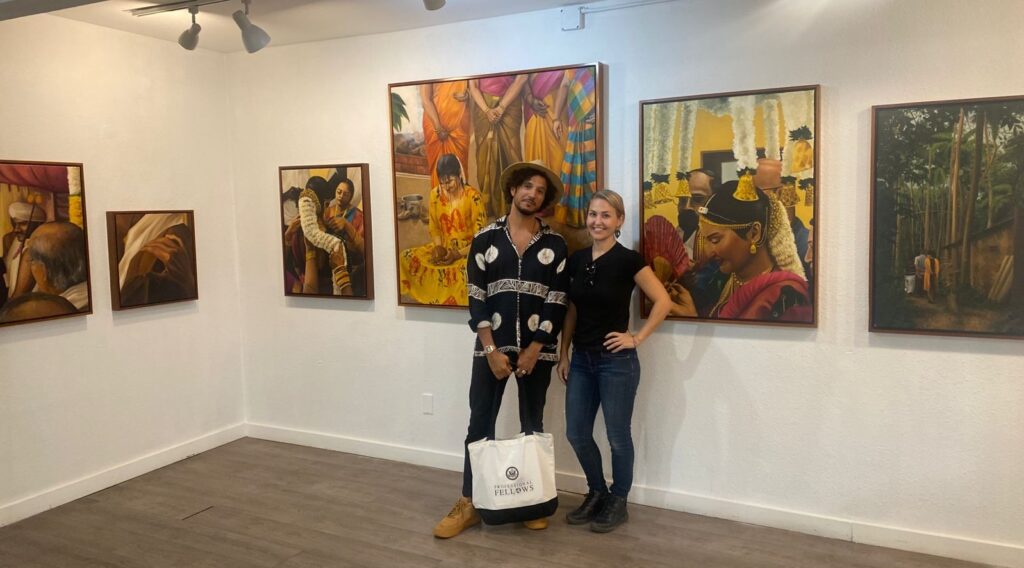
During the fellowship, I attended numerous cultural events, exhibitions, and artist gatherings, engaging deeply with Austin’s vibrant creative scene. I also co-curated an exhibition with Almost Real Things, my host organization in Austin, Texas. The exhibition, entitled Kin, explored kinship as both a personal and collective experience, creating a dialogue that was at once intimate and universal. Through artists with dual cultural backgrounds, Kin examined how memory is carried, reshaped, and transmitted across generations, revealing shared connections alongside distinct cultural identities.
Beyond exhibition-making, the fellowship enabled engagement with cultural policy through meetings at Austin City Hall and conversations with artists and policymakers about public investment and long-term cultural strategy. Equally meaningful were exchanges on artist support, artificial intelligence, collective data, and Austin’s potential as an international art destination.
One particularly moving moment was attending a naturalization ceremony, which prompted reflection on belonging, identity, and the coexistence of multiple histories within a shared civic framework.
Ultimately, the fellowship reaffirmed my conviction that art is a powerful space of encounter—one that transcends geography and positions diversity as a source of strength. Returning to Morocco and to Fez Gathering, I carry these experiences forward as tools for strengthening artistic ecosystems and advancing art as a practice of care and collective transformation.
I am currently preparing the 8th edition of Fez Gathering, which will welcome the United States as Guest of Honour in conjunction with the celebration of 250 years of U.S. independence. This recognition honors the historic bond between the two nations, rooted in Morocco’s early recognition of the United States and sustained through centuries of cultural exchange. This year’s Gathering offers Moroccan audiences a meaningful window into the rich and diverse artistic landscape of the United States—one that remains underrepresented locally.